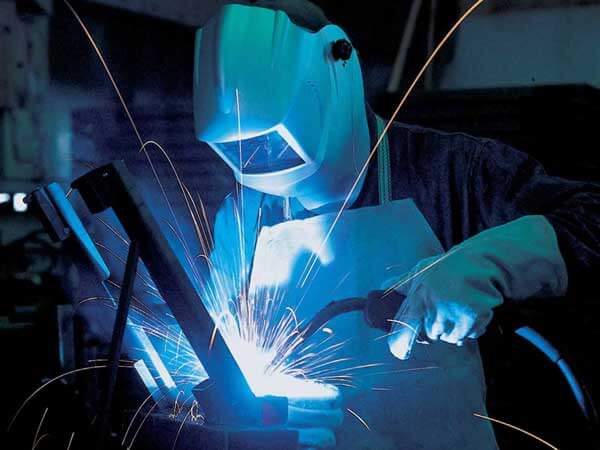
 The process of joining two pieces of metal together is known as welding. The aim is to join the metals in a way that they form a strong bond. Welding is most commonly used to weld together sheet metal, galvanized pipes and aluminum panels. Different kinds of metals require a specific types of welding. Since the process and the end results are similar, a common misconception is that there is only one kind of welding.
For example, a thin piece of metal would require a welding procedure that does not expose the metal to extensive heat. While a thicker metal pipe will require higher temperatures for maximum penetration. It is essential to know about the types of welding for different metals because if a thin gauge metal is exposed to a welding procedure that emits a lot of heat, it would melt the metal.
Mainly there are two types of welding:
- Gas Welding
- Arc Welding
Gas Welding
Gas welding is done with the help of a gas torch. The torch creates a flame which heats the metal and the flux creating a firm bond. There are three kinds of torches that are used in gas welding.
Oxyacetylene Torch
The oxyacetylene torch emits the most amount of heat. This torch is considered to be universal. It can be used for a variety of tasks including cutting sheet metal. Soldering is also made possible because the heat emission can be controlled. The oxyacetylene torch requires caution because the heat emission is tricky to control.
Oxy-propane Torch
The oxy-propane torch is limited to delivering low heat and is mostly used for soldering or heating. This torch is quite in expensive to use. However, the use is not quite versatile.
Propane Torch
The Propane torch much like the oxy-propane torch emits low heat and is limited to soldering and heating purposes.
Arc Welding Types
Arc welding creates heat with the help of an electronic arc. Arc welding is basically an electrical short circuit. The metal that needs welding is grounding to one terminal of the arc and the second terminal has the electrode or welding rod. When the electrode touches the metal it creates a short circuit and generates heat. There are three types of Arc Welding.
Basic AC & DC Welding
This welding comes in handy when working with heavy gauge metal. AC & DC arc welding uses a welding rod which is made of flux and coated in metal. The rod is then guided along the joints resulting in a weld.
Metal Inert Gas – MIG Welding
MIG welding is quicker than basic arc welding. It is ideal for use with sheet metal and is performed with a DC arc.
Tungsten Inert Gas – TIG Welding
The TIG welding uses a Tungsten electrode. TIG welding is performed on an AC arc and is ideal for welding metals that have low melting point like aluminum. This type of welding is also quite effective in welding sheet metal.
The most widely used torch in gas welding the oxyacetylene. The ability to control the heat output is what makes it popular. On the other hand, when it comes to Arc welding, each type serves a specific purpose. However, the welding bonds of the Basic AC and DC Welding are the strongest.